
- The Wayfinder
- Frameworks & Frictions
The IndiGo 6E fiasco revealed a compliance failure embedded in the intersection of airline obligations and regulatory oversight. Under DGCA’s own frameworks, airlines must demonstrate aircraft and crew capacity before seasonal schedules are approved. Yet the December collapse suggests that IndiGo 6E may have overstated its ability to operate under the revised FDTL norms, and that the DGCA approved the winter schedule without the level of scrutiny the rulebook demands.
IndiGo 6E denies any deliberate act, but Parliament’s assessment was blunt: both the airline and the regulator were evasive when questioned about the breakdown. Misrepresentation on one side and oversight lapses on the other created a perfect storm, one that stranded passengers, exposed systemic fragility, and raised uncomfortable questions about how India’s aviation governance functions when pressure meets policy.
The Rulebook DGCA Did not Enforce
The revised fatigue‑management rules were meant to reset how Indian aviation planned and operated its schedules. Instead, the winter season exposed how quickly a regulatory framework can weaken when enforcement fails to align with the rulebook’s intent. The gap between what the norms required and how they were applied became the first visible compliance failure, setting the stage for the disruption that followed.
What the Revised FDTL Framework Required
DGCA introduced the revised FDTL framework to correct long‑standing fatigue‑risk gaps in Indian aviation and align it with ICAO standards. It tightened early‑morning duty limits, revised limits on the number of night landings, increased mandatory rest periods, and required airlines to demonstrate that their schedules could operate within these constraints without relying on last‑minute fixes. The intent was to shift fatigue management from reactive adjustments to proactive planning. The norms expected airlines to model peak‑season loads, identify fatigue‑sensitive patterns, and maintain reserve crews capable of absorbing routine disruptions. Airlines were required to comply by furnishing demonstrated data, not assumptions.
A Compliance Framework That Existed Only on Paper
In practice, the framework’s strength never translated into enforcement. Airlines filed schedules, but the supporting evidence the new norms required, such as fatigue‑risk modelling, reserve‑crew buffers, and scenario testing, was not consistently examined. The approval process remained unchanged even though the regulatory standard had evolved. This process created a system in which compliance existed only in documentation, not in verification. The rules were updated, but the oversight mechanism stayed static, leaving the framework effective only on paper.
The Collapse That Followed
Once operations entered the winter peak, the system exposed stresses that the airlines had misrepresented during the approval stage. Delays piled up, buffers disappeared, and the network unravelled, revealing more profound structural weaknesses. The disruption did not strike suddenly; instead, it unfolded as the predictable result of a compliance failure already built into the schedule.
IndiGo 6E’s Winter Schedule Unravels
The winter schedule began to strain almost immediately. Indigo 6E delayed their flights, slipped rotations, and exhausted reserve crews early in the day. What should have been routine seasonal pressure escalated into widespread cancellations. The network showed signs of structural weakness: tight turnarounds, minimal buffers, and a roster built on optimistic assumptions rather than operational resilience. Once the first disruptions appeared, the system had no capacity to recover.
Why the Pattern Suggests Overstated Capacity
The scale and speed of the breakdown indicated that Indigo 6E built the schedule on capacity that it did not fully possess under the revised norms. Crew availability under tighter fatigue limits was narrower than before, yet the schedule appeared to assume pre‑revision flexibility. The mismatch between planned operations and actual crew strength became apparent only under stress. The pattern suggested that the airline’s declared capacity did not align with the operational reality required by the updated framework.
The Polygraph of Compliance
Operational stress functions as a real‑time audit. When a schedule collapses under predictable seasonal pressure, it reveals the assumptions embedded in its design. In this case, the disruption exposed the gap between declared compliance and actual capability. The revised norms required resilience; the schedule delivered fragility. The collapse became the polygraph of compliance, revealing what the approval process did not test.
DGCA’s Oversight Gap
The most revealing part of the December crisis was not the operational collapse itself, but the regulator’s response to it. DGCA’s oversight gap became evident when IndiGo 6E’s network began to strain, not because the rulebook was unclear, but because enforcement shifted in real time to accommodate the airline’s constraints. With more than 60% domestic market share, IndiGo’s disruption effectively became a national one, and the DGCA responded as though the system had no alternative but to bend.
Instead of applying the revised FDTL norms with the consistency they demanded, the regulator issued temporary relaxations that weakened its own safety framework. This failure was not a dispute over interpretation; it was a structural compliance failure in which the regulator adjusted the rules to fit the airline rather than requiring the airline to comply with the regulations. The imbalance was stark: a dominant carrier exerting gravitational pull, and a regulator responding to the crisis by diluting the very protections it had introduced.
The same pattern appeared in passenger rights. DGCA’s Civil Aviation Requirements mandate full refunds and cash compensation for cancellations and long delays. Yet IndiGo 6E deducted charges, issued partial compensation, and substituted mandated refunds and compensation with time‑bound vouchers, many of which passengers reported never receiving. These practices continued despite explicit instructions from the regulator, exposing a second compliance failure: DGCA’s inability to ensure that the airlines follow its own consumer‑protection rules, leaving passengers with no recourse other than approaching consumer courts.
This failure was not merely an oversight gap. It was a moment when the system tested the regulator’s authority and found it to be negotiable.
Approval Without Verification
DGCA approved the winter schedule without requiring the evidence that the revised norms demanded. The regulator did not request fatigue‑risk modelling, did not examine reserve‑crew buffers, and did not test whether the schedule could withstand routine disruptions. The approval process treated the filing as complete even though the regulatory environment had changed. By validating the schedule without verification, DGCA allowed a compliance weakness to enter the system at the point where scrutiny should have been strongest.
Parliament’s View: Evasive Responses From Both Sides
When the disruption reached Parliament, lawmakers sought clarity on how DGCA approved the schedule. Neither the airline nor the regulator provided a clear account. IndiGo did not explain how its crew‑availability calculations aligned with the revised norms, and DGCA did not present documentation showing what it had reviewed before approving. The responses were incomplete and evasive, leaving Parliament unable to trace the decision‑making chain. The lack of transparency revealed a structural weakness: the system lacked a documented method for demonstrating how DGCA made regulatory decisions.
The Regulator’s Role in the Compliance Failure
IndiGo did not apply DGCA’s compensation and refund framework as written. Instead of issuing full refunds after cancellations, the airline deducted various charges. It replaced time‑bound cash compensation with vouchers that many passengers say they never received or could not use. Travellers who tried to escalate their cases found little practical support from DGCA, which appeared more focused on protecting the airline’s operational stability than enforcing passenger rights. This pattern turned an operational disruption into a deeper compliance failure: the rulebook existed, but the promised protections did not reach the people they were intended to protect.
DGCA’s posture during the crisis reflected a reluctance to challenge the operational assumptions of the country’s largest carrier. Instead of enforcing the revised norms, the regulator adjusted its stance once the disruption began, issuing temporary relaxations that softened the safety framework. The same pattern appeared in consumer protection: despite precise CAR requirements, the regulator inconsistently enforced the rules it framed. This lapse revealed a second layer of vulnerability, a rulebook that existed, but an enforcement mechanism that did not function consistently. The compliance failure was not only operational but also institutional.
By stepping back when enforcement was most needed, the regulator allowed the compliance failure to spread from scheduling to passenger rights and finally to the airport floor.
Passengers Caught in the Friction
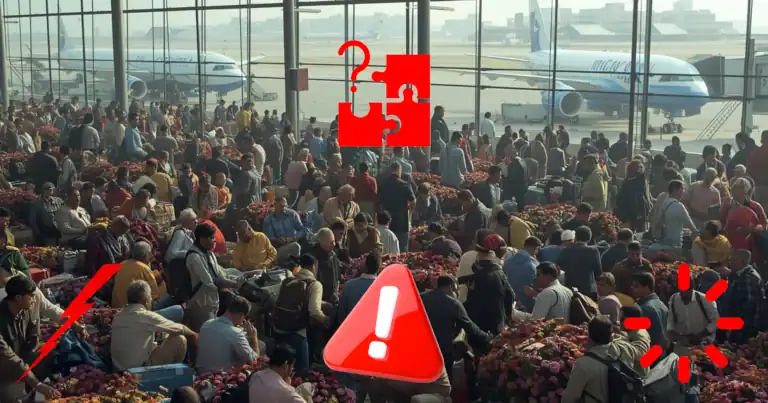
As the schedule collapsed, the real cost of the compliance failure became apparent at the terminal, not in the timetable. Passengers found themselves stranded in crowded halls with no refreshments, no meal vouchers, no hotel accommodation, and no clear information on when, or even if, relief would be forthcoming. Phone lines did not connect, airport counters could not cope, and ground staff absorbed anger for decisions they had not made and could not explain. Checked‑in baggage went missing or was withheld, forcing many travellers to leave without their belongings. The scene resembled a bus depot more than a regulated aviation system, exposing how quickly passenger rights disappeared once the regulator stopped enforcing its rulebook.
The chaos that unfolded in terminals showed how a compliance failure on paper becomes a lived experience for passengers when safeguards fail to activate.
Refunds, Deductions, and the Voucher Problem
The disruption exposed a second layer of passenger impact: the breakdown of DGCA‑mandated refunds and compensation. Instead of issuing full refunds for cancelled flights, IndiGo deducted various charges that the rulebook does not permit. Passengers who were entitled to cash compensation received vouchers instead, many of which were either non‑functional, expired on arrival, or never delivered. Several travellers reported that the airline closed refund requests without processing them, leaving customers to chase outcomes through call centres that rarely connected. The refund process became another layer of the same compliance failure, where the airline replaced DGCA-mandated protections with discretionary practices.
The pattern was consistent across airports and dates. Families who paid for round‑trip tickets received partial refunds that did not comply with the fare rules. Indigo 6E told the elderly passengers, “Wait for an email,” but none arrived. Some travellers received automated messages claiming their refunds had been processed, only to discover that no refunds had been credited to their accounts. Indigo 6E offered vouchers to passengers that could not be redeemed online or imposed route restrictions that passengers could not use.
Attempts to escalate these cases met a wall. DGCA’s grievance channels acknowledged complaints but offered little practical resolution. Passengers who cited the Civil Aviation Requirements found that the enforcement mechanism behind those rights was effectively absent. The gap between what the rulebook promises and what passengers actually received turned a service disruption into a financial and procedural burden, one that many travellers had no means to contest.
This disruption was not merely inconvenient; it was a systemic failure in how the airline handled refunds and compensation. The airline’s deductions, the substitution of vouchers for cash, and the failure to deliver promised remedies revealed a breakdown of the most basic consumer‑protection obligations. For passengers, the disruption did not end with a cancelled flight: instead, it continued through a refund process that functioned more like a barrier than a remedy.
For passengers trying to understand what they were actually entitled to, the rules themselves were not the problem; accessibility was. We have mapped these obligations in plain language in our guide to DGCA Civil Aviation Requirements, so travellers can see precisely where airline practices diverge from the standards the regulator has already published.
Communication Failures and Airport Chaos
Airports were unprepared for the surge of stranded passengers. Information screens lagged behind reality, call centres failed to connect, and counters provided conflicting instructions. With no functioning communication system, travellers had no clear sense of whether to wait, rebook, or leave. Ground staff, already stretched thin, were forced into crowd‑control roles for which they received no training, and they absorbed the frustration they could not resolve.
Basic support collapsed alongside communication. The airline did not distribute refreshments or meal vouchers and made no hotel arrangements even during overnight delays. Families slept on terminal floors, elderly passengers waited without assistance, and many relied on social media for updates because official channels stayed silent. Baggage handling also broke down, with several passengers leaving without their checked‑in bags. The scene resembled unmanaged public transport rather than a regulated aviation environment. The absence of structured communication turned a predictable disruption into a cascading compliance failure across airport operations.
When DGCA Offers No Recourse: Turning to Consumer Courts
With DGCA offering no practical enforcement mechanism, passengers have only one effective remedy: the consumer court system. Unlike DGCA, consumer courts can order refunds, compensation, interest and penalties for service deficiencies. The process is straightforward. Passengers must file a complaint with their district consumer commission and attach proof of booking, cancellation, denial of refund, and any written communication with the airline. Claims under ₹5 lakh require no lawyer, and the presiding officers conduct hearings with minimal formality. Courts routinely rule in favour of passengers when airlines impose charges, deny refunds, or fail to provide mandated support during disruptions. For travellers who received no assistance from DGCA, consumer courts remain the only forum in which rights translate into enforceable outcomes.
Despite the clear rights laid out in the rulebook, passengers increasingly find that DGCA has shifted from an enforcement body to what many describe as the protector general of civil airlines. Its operational posture prioritises airline stability and profitability over passenger remedies, leaving travellers with no meaningful recourse when airlines deny refunds, compensation, or basic support. This institutional stance deepens the compliance failure, forcing passengers to rely on consumer courts because the regulator no longer functions as an adequate safeguard.
MoCA Clears Three New Airlines
Even as the winter disruption exposed structural weaknesses in scheduling, oversight and passenger protection, the Ministry of Civil Aviation moved ahead with approvals for three new airlines. The timing raised questions about whether the system was expanding capacity without first addressing the compliance failure already visible in the country’s largest carrier. Growth continued, but the regulatory foundation beneath it remained unchanged.
Expansion Without Strengthening Oversight
MoCA’s decision to clear new entrants signalled confidence in the sector’s growth trajectory, but it did not come with any parallel strengthening of oversight. The revised FDTL norms were still unevenly enforced, DGCA’s passenger‑rights mechanisms remained ineffective, and the winter disruption had shown how quickly the system could collapse under predictable stress. Approving new airlines without reinforcing the regulatory framework risked multiplying the same vulnerabilities across more operators.
The concern was not about competition as India needs more airlines, but about whether the oversight architecture could support them. Without stronger verification processes, transparent schedule approvals and enforceable passenger protections, new entrants would inherit the same structural weaknesses that triggered the recent crisis.
What the IndiGo Crisis Means for New Entrants
The IndiGo disruption became a case study for what happens when growth outpaces governance. New airlines entering the market will face the same fatigue‑risk rules, crew‑availability constraints, and passenger‑rights obligations. But unless DGCA enforces these standards consistently, operators may feel incentivised to stretch capacity in ways that mirror the very compliance failure that triggered the winter collapse.
A quieter but equally important factor is the regulator’s incentive structure. Industry insiders have long noted that DGCA staff routinely receive complimentary upgrades and travel perks from airlines, benefits that subtly align with airline interests rather than passenger rights. When airlines enhance the regulator’s lived experience with preferential treatment, the regulator’s enforcement posture naturally softens. For new entrants, this means they are entering a system in which the rulebook exists, but the incentives for enforcement are misaligned.
The lesson from IndiGo is clear: without a regulator that enforces standards impartially and consistently, adding more airlines does not strengthen the market. It simply increases the number of points at which the system can fail.
Conclusion: A System That Failed at the Point of Truth
The winter disruption did more than expose operational weaknesses. It revealed a structural imbalance in India’s aviation ecosystem. Rules existed, but enforcement did not. DGCA wrote the passenger rights, but never delivered them. They updated oversight frameworks, but never applied them. At the point of truth, when the regulator tested the system, every layer intended to protect the traveller failed simultaneously. The compliance failure was not a single event; it was the sum of institutional choices made over the years.
The Path Forward
India’s aviation sector cannot continue to expand on a regulatory foundation that buckles under predictable stress. Airlines must demonstrate absolute compliance with fatigue‑risk rules, not just file schedules that look compliant on paper. DGCA must enforce its own Civil Aviation Requirements consistently, transparently and independently, not selectively, and not only after a crisis. Passenger‑rights mechanisms must shift from symbolic to functional, with clear timelines, penalties and escalation paths that actually work.
Trust is the foundation of aviation: trust in realistic schedules, trust in the enforcement of safety rules, and trust that airlines will not abandon passengers when things go wrong. As the writer and philosopher Albert Camus observed, “Integrity does not need rules.” The inverse is also true: when integrity weakens, even the strongest rulebook becomes meaningless. The winter disruption proved that India’s aviation system cannot rely on written norms alone; instead, it needs institutions willing to uphold them.
Rebuilding Credibility Through Enforcement, Not Announcements
Announcements of new airlines, new routes or new policies will not restore confidence unless DGCA rebuilds the enforcement architecture. DGCA must demonstrate that it can act independently of airline influence, including the soft incentives, such as upgrades, preferential treatment, and travel perks that quietly shape regulatory posture. A regulator who experiences the industry as a privileged traveller cannot fully understand the reality faced by passengers stranded on terminal floors.
Rebuilding credibility requires three immediate steps:
- Verification before approval, not after collapse
- Enforcement without exceptions, not selective compliance
- Passenger remedies that function, not promises that evaporate at the airport
Only then will the system regain the trust it lost, not through statements, but through actions that hold up under pressure.