
- The Wayfinder
- Frameworks & Frictions
On June 12, 2025, Air India Flight AI 171 crashed shortly after takeoff from Ahmedabad, marking the first fatal accident involving a Boeing 787. With 242 people on board, the aircraft suffered a catastrophic loss of thrust, triggering urgent scrutiny of cockpit systems, fuel control switches, and the design logic behind engine cutoff protocols.
Understanding the Air India AI 171 Crash
The crash of Air India Flight AI 171 on June 12, 2025, marked a turning point in aviation safety. Within seconds of takeoff from Ahmedabad, the Boeing 787 suffered a dual-engine shutdown, triggered by fuel cutoff switches, leading to a fatal descent into a residential building. This post examines the cockpit systems, thrust logic, and investigative findings that now define one of India’s deadliest aviation disasters.
Sequence of Events Leading to the Crash
What began as a routine departure from Ahmedabad quickly unraveled into one of India’s deadliest aviation disasters. The Air India AI 171 crash unfolded within seconds of takeoff, triggered by a dual-engine shutdown that investigators traced to the aircraft’s fuel control switches. Reconstructed from cockpit voice recordings, flight data logs, and CCTV footage, the timeline reveals a chilling sequence of manual inputs, system responses, and unanswered distress calls, each moment exposing the fragility of cockpit logic under pressure.
Descent and Impact
Seconds after the dual-engine shutdown, Air India AI 171 began a steep, uncontrolled descent. With no thrust and limited altitude, the Boeing 787 veered off its flight path. It struck a residential building near the airport perimeter. The impact destroyed multiple floors, ignited a fuel-fed fire, and left 241 fatalities among the 242 passengers and crew. One survivor, Viswashkumar Ramesh, was flung clear of the wreckage and later found walking barefoot through debris. His survival is considered a rare anomaly in India’s deadliest Boeing 787 crash. CCTV footage and flight data confirm that no distress call was transmitted, possibly due to rapid system failure or cockpit overload.
Cockpit Systems Under Scrutiny
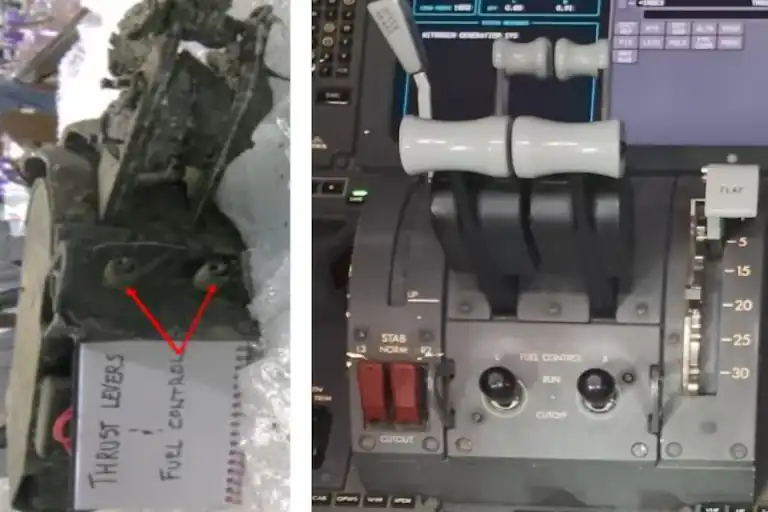
The Air India AI 171 crash has placed the Boeing 787’s cockpit systems under renewed investigation. Seconds after takeoff, the aircraft’s Ram Air Turbine (RAT) deployed, an emergency response to hydraulic or electrical failure that activated backup systems and altered cockpit logic. Shortly afterward, both fuel control switches were moved to CUTOFF, resulting in a dual-engine shutdown.
This sequence has raised critical questions about cockpit ergonomics, system redundancy, and interface design. Investigators and aviation experts are examining whether the layout and tactile feedback of critical switches may have contributed to a misdiagnosed emergency, one that escalated into a catastrophic failure.
Fuel Control Switches and Cutoff Logic
Seconds after takeoff, the aircraft’s Ram Air Turbine (RAT) deployed, an emergency mechanism triggered by a loss of hydraulic or electrical power. This activation triggered the aircraft to enter backup mode and modify its cockpit logic. Shortly afterwards, both fuel control switches were moved to the cutoff position. Whether this was a misdiagnosed response to system failure or a momentary lapse remains under investigation.
During the descent, cockpit voice recordings captured one pilot asking, “Why did you cut off the fuel?” The other replied, “I didn’t.” Both switches were then returned to RUN, prompting the aircraft’s automated engine relight system. Engine 1 began to recover, but Engine 2 failed to maintain core speed despite repeated attempts to reintroduce fuel.
The timeline reveals a troubling sequence: although the RAT was deployed during takeoff, it did not begin supplying power until four seconds after the fuel switches were transitioned. This delay suggests the aircraft may have already entered a deeper emergency state before the cutoff, and the crew’s response, however well-intentioned, may have compounded the crisis.
Investigators recovered both switches in the RUN position, consistent with the crew’s attempt to restart the engines midair. Aviation experts note that accidental activation is unlikely. Each switch requires a deliberate lift-and-toggle motion and operates independently with built-in safeguards.
This incident has reignited scrutiny of cockpit interface design, particularly the placement, tactile feedback, and cognitive load associated with critical switches. The central question remains: did the system fail the pilots, or did the interface allow a misread moment to become irreversible?
Air India AI 171 Crash in Regulatory Context
The Air India AI 171 crash has exposed critical fault lines in India’s aviation oversight and international liability frameworks. While the Aircraft Accident Investigation Bureau (AAIB) has yet to deliver a conclusive report, legal scrutiny is intensifying under the Montreal Convention (1999), the global treaty governing airline liability for death, injury, and system failure during international travel.
India, as a signatory, is bound by the Convention’s two-tier compensation system:
- A no-fault liability of approximately ₹1.91 crore per passenger
- An uncapped liability if negligence or misconduct is proven, whether by the airline, manufacturer, or regulatory body
In this case, families have already challenged the preliminary report’s focus on pilot actions, arguing that systemic failure, possibly related to electrical or design issues, played a decisive role. Legal experts are now exploring product liability claims against Boeing, citing interface design concerns reminiscent of the 737 MAX cases.
Domestically, the crash has reignited debate over India’s fragmented aviation laws, including the Aircraft Rules (1937) and the Bharatiya Vayuyan Adhiniyam (2024). Critics argue that these frameworks lack harmonisation with ICAO standards and fail to enforce cockpit interface regulations that could have prevented the misdiagnosis of the fuel cutoff.
“Rather than presupposing what particular claims might be brought, we prefer to allow the evidence to drive any allegations. In this case, we want and need the flight data recorder information to determine exactly what happened.”
- Mike Andrews, Lead Attorney, Beasley Allen Law Firm
Montreal Convention and Liability Framework
The AI 171 crash falls squarely within the scope of the Montreal Convention (1999). This treaty defines airline liability in cases of passenger injury or death. Its provisions on system failure, negligence, and compensation thresholds are now central to the legal response. The Convention’s uncapped liability clause may apply if cockpit design flaws or procedural lapses are proven to have contributed to the crash.
ICAO Safety Protocols and Cockpit Interface Standards
The incident has prompted renewed scrutiny of ICAO safety protocols, particularly those governing cockpit interface design, fuel control logic, and emergency system redundancy. Investigators are now evaluating whether the Boeing 787’s layout met ICAO’s Human Factors Design criteria, and whether India’s regulatory adoption of these standards remains consistent across aircraft types.